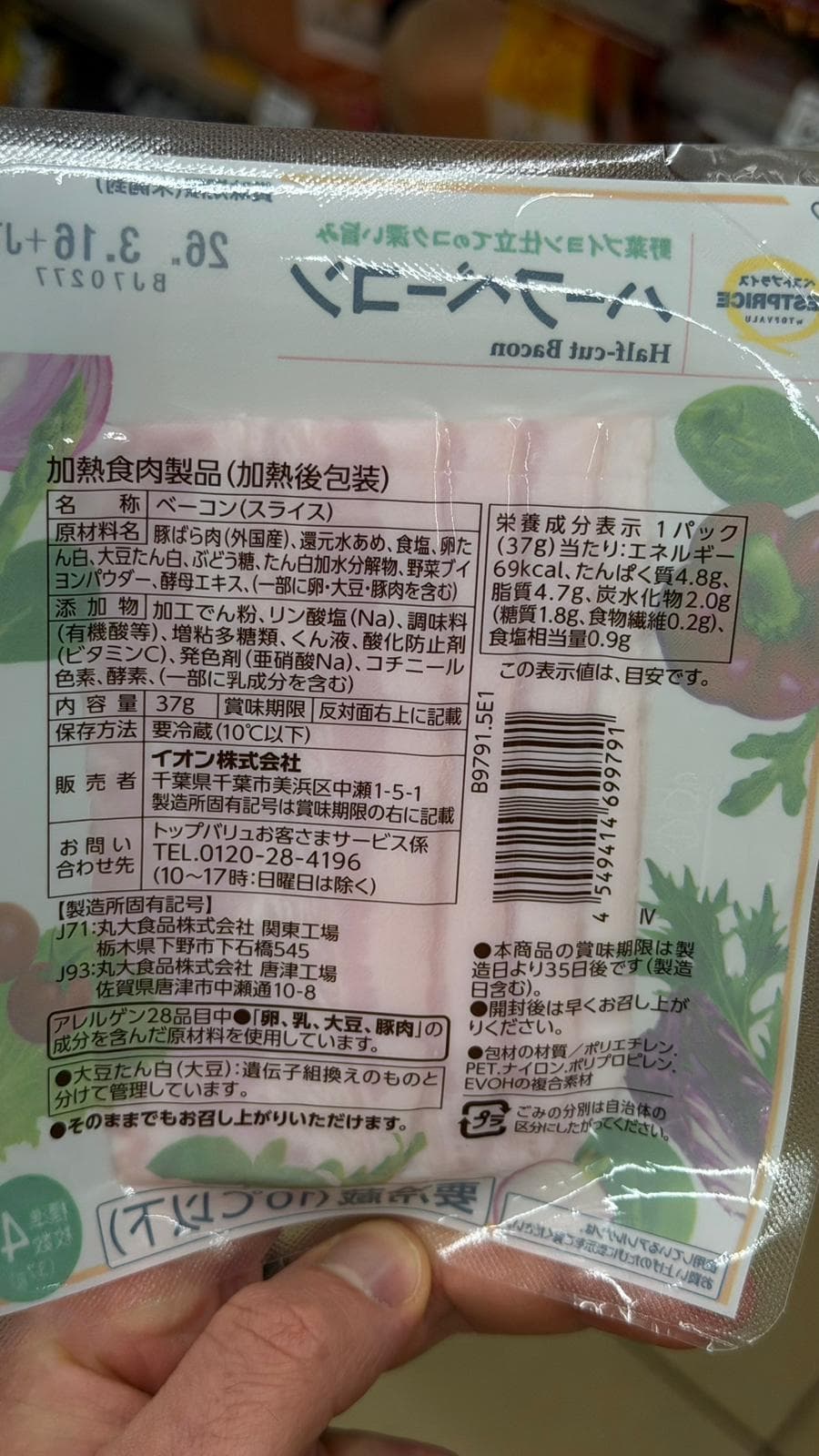
MoguMogu (iPhone) and Foodfit Japan (iPhone and Android) check a Japanese food label against your diet for free; Halal Japan and Halal Lens check halal only, Payke shows a product's details from its barcode, and Google Translate translates the words. Okaasan, the paid web app that publishes this guide, checks labels and restaurant menus for allergens, halal, kosher, vegan, vegetarian and gluten-free in one result; on 115 real Japanese labels in November 2026, it made 0 dangerous mistakes, against 3 for ChatGPT (GPT-6.1) (how Okaasan tests). Whatever the app, read the allergen box on the pack yourself if you have a serious allergy.
Who wrote this. Okaasan publishes this guide and is one of the nine apps compared. What it says about the eight others comes from each app's own App Store page, Google Play page, website or press release, read on November 8, 2026 and checked again on November 14, and it says when something couldn't be confirmed. The apps were not tested side by side, except ChatGPT, Claude and Gemini, which Okaasan tested on the same 115 labels as itself: for the others, this compares what each app says it does, not how well it does it.
The nine apps at a glance
Of the nine apps, four check a label against your diet or allergies, two check halal only, Payke shows a product's details from its barcode, Google Translate translates, and ChatGPT answers questions about a photo.
| App | Best for | Reads | Works on | Price |
|---|---|---|---|---|
| Okaasan | Labels and restaurant menus, every diet in one result | Barcode, then a label photo; menu photos | Web app | From $9 a month, or $14 once for 31 days |
| MoguMogu | Allergies and diets, for free | Barcode or label photo | iPhone | Free |
| Foodfit Japan | Diets, in 30 languages | Label photo | iPhone, Android | Free |
| What's in it? | Your own allergy list | Label photo or typed text; barcode, says its website | iPhone | Free, with paid passes |
| Payke | Product details from a barcode | Barcode | iPhone, Android | Free |
| Halal Japan | Halal from a barcode | Barcode | iPhone | Free, premium from ¥200 a month |
| Halal Lens | Halal, in the Halal Gourmet Japan app | Barcode or label photo | Phone app | Not stated |
| Google Translate | Translating the words | Camera, live or on a photo | iPhone, Android | Free |
| ChatGPT | Asking questions about a photo | Photo and your question | iPhone, Android, web | Free plan, paid plans |
What does each app check?
Okaasan, MoguMogu and What's in it? are the three of the nine whose descriptions cover allergens, halal, vegan and vegetarian, and only Okaasan reads a photo of any restaurant menu.
| App | Allergens | Halal | Vegan, vegetarian | Restaurant menus |
|---|---|---|---|---|
| Okaasan | Yes | Yes | Yes | Yes, from a photo |
| MoguMogu | Yes | Yes | Yes | Only restaurants that publish theirs in the app |
| Foodfit Japan | Gluten and lactose | Yes | Yes | Not stated |
| What's in it? | Yes, your list | On its website | On its website | Not stated |
| Payke | No | No | No | Not stated |
| Halal Japan | Not stated | Yes | Not stated | Not stated |
| Halal Lens | Not stated | Yes | Not stated | Not stated |
| Google Translate | Translation only | Translation only | Translation only | Translation only |
| ChatGPT | If you ask | If you ask | If you ask | If you ask |
"Not stated" means the app's store page and website don't mention it.
Which app fits your diet or allergy?
For an allergy, pick an app that checks your own allergy list; for halal, vegan or gluten, one that checks where each ingredient comes from; for restaurants, one with a menu mode.
- A food allergy. MoguMogu, What's in it? and Okaasan check your own allergy list. Read the allergen box on the pack as well. Since April 1, 2026, Japanese labels must declare nine allergens: egg, milk, wheat, buckwheat, peanut, shrimp, crab, walnut and cashew nut; packs have until March 31, 2028 to add cashew nut, so an older pack may not list it. Twenty more, such as sesame, soy and pistachio, are only recommended (Consumer Affairs Agency, allergen handbook, April 2026; Sakai City). Both lists, and what to say in a restaurant, are in the food allergy guide.
- Halal. Halal Japan and Halal Lens check halal only; MoguMogu, Foodfit Japan, What's in it? (according to its website) and Okaasan check it along with other diets. The words that rule it out, such as ポークエキス (pork extract) and ラード (lard), are in the halal guide.
- Vegan or vegetarian. Foodfit Japan, MoguMogu, What's in it? (according to its website) and Okaasan check both. Fish stock hides in products that don't look like fish, as だし (dashi) or かつおエキス (bonito extract): see the rice crackers below and the vegan and vegetarian guide.
- Gluten-free. Foodfit Japan says it checks gluten-free, and Okaasan shows a gluten-free flag. Japanese labels must declare wheat (小麦), but barley (大麦) and malt (麦芽) are on neither allergen list (Consumer Affairs Agency, allergen Q&A; Sakai City), and soy sauce is usually brewed with wheat: the Wadakan koikuchi soy sauce tested by Okaasan lists 小麦 second, after defatted soybeans (脱脂加工大豆). Okaasan's safety net doesn't read oats (オーツ麦) as of November 2026. Details in the gluten-free guide.
- Eating out. Of the nine apps, only Okaasan describes reading a photo of a restaurant menu, ticket machines included; MoguMogu shows the menus of restaurants that publish theirs in the app, ChatGPT can describe a menu photo if you ask, and Google Translate gives you the dish names. A menu gives a dish's name, not its recipe, so ask the staff about allergens. The izakaya menu guide shows which dishes hide dashi, pork or alcohol.
- A language other than English. Foodfit Japan (30 languages) and Payke (7) offer the widest choice; Okaasan works in 4 (English, French, Chinese and Japanese).
- Only what a product is. Payke or Google Translate.
How accurate are ChatGPT, Claude and Gemini on Japanese food labels?
On 115 real Japanese food labels tested by Okaasan in November 2026, ChatGPT (GPT-6.1) showed 3 answers as fine when the label said otherwise, Claude (Opus 5.5) 21 and Gemini (Auto) 50; after its safety net, Okaasan showed 0 in 345 analyses (how Okaasan tests).
ChatGPT and Claude ran on their paid plans, Gemini in its free app. Each got the same question for every product: is it halal, kosher, vegan, vegetarian or gluten-free, and does it contain pork, alcohol, dairy, soy, seafood or caffeine? Every answer was compared with the label.
| Okaasan | ChatGPT (GPT-6.1) | Claude (Opus 5.5) | Gemini (Auto) | |
|---|---|---|---|---|
| Dangerous mistakes (shown as fine when the label says otherwise) | 0 | 3 | 21 | 50 |
| "Unclear" when the label gave the answer | fewer than 1 in 500 | about 1 in 8 | about 1 in 22 | about 1 in 26 |
- ChatGPT was careful but often unsure, and called a rice cracker with bonito vegan, vegetarian and seafood-free.
- Claude read every ingredient list right, but answered "no" 21 times for an allergen the label names in its factory warning, such as milk on three HARIBO packs.
- Gemini made the same mistake as ChatGPT on the rice crackers, called an instant ramen with pork stock pork-free and called HARIBO gummies with gelatin vegetarian.
- Okaasan was 70 times more reliable than ChatGPT, 35 times more than Claude and 57 times more than Gemini, counting every answer you can't rely on: a wrong one, or "unclear" when the label gave the answer.
The rice crackers are Salad senbei (サラダせん), made by 丸武古泉商店 in Niigata; their label was photographed upside down for the test. Its ingredient list reads:
うるち米(米国産、国産)、植物油脂、でん粉、食塩、カツオエキスパウダー/加工でん粉、調味料(アミノ酸等)、植物レシチン、(一部に大豆を含む)
カツオエキスパウダー is bonito extract powder, made from fish, and the closing bracket names only 大豆 (soy). In Okaasan's own scans of this label, Okaasan's AI called these crackers vegan and vegetarian too, in 3 analyses out of 3; the safety net read カツオ in the Japanese list and corrected it each time, before the result was shown.

Not vegan or vegetarian. カツオエキスパウダー (bonito extract powder) is fish.
In the November 2026 comparison above, Okaasan's AI on its own, given the same labels and the same question without Okaasan's safety net, made 40 dangerous mistakes, more than ChatGPT or Claude. What makes the difference is the safety net, which compares every answer with the label's Japanese ingredient list before you see it, and can only make an answer more careful.
This is Okaasan's own test, with its limits: 115 products chosen for their traps, one answer per product from each assistant and three from Okaasan, a prompt written for the test, one date. A 0 is a test result, not a guarantee. The method and its limits are on the how Okaasan tests page.
The apps, one by one
Okaasan
Okaasan reads a photo of a Japanese food label or a restaurant menu and checks it against the diets and allergies in your profile. For a product, the camera reads the barcode first: a product already in Okaasan's shared product base comes back at once, without a photo, but as of November 2026 that base is still small, so most products are read from one or two photos of the pack, back and front. Okaasan's AI reads the label, then Okaasan's safety net compares every diet answer with the label's Japanese ingredient list, and shows "unclear" when the list can't settle it.
A product result gives:
- a verdict for your profile: "Not for you", "All clear" or "Some points are unclear";
- the ingredient list, translated;
- the allergens from both Japanese lists, with an alert for the ones in your profile, and the factory warning (本品製造工場では…) shown apart;
- halal, kosher, vegan, vegetarian and gluten-free flags, and whether it contains pork, alcohol, seafood, dairy, soy or caffeine;
- the additives ranked by level of concern, an estimated Nutri-Score and NOVA level, and the nutrition facts;
- the price in dollars, and products to buy instead at 7-Eleven, Lawson and FamilyMart.
The menu mode reads printed, handwritten and wall menus, and ticket machines (食券機, shokkenki) button by button. Each dish gets a translation, its price, its likely ingredients, diet flags and an estimated calorie range. In Okaasan's November 2026 tests, the menu scan found 471 of the 475 dishes looked for on 15 real menus and read all 15 prices checked; on a soba shop's ticket machine, it read all 54 buttons in each of 3 analyses and got 90 of 90 checked prices right (how Okaasan tests). The site and its results are in English, French, Chinese and Japanese.
What to know: it's paid only, with no free plan or trial: $9 a month for the first 30 subscribers ($20 after that), or $14 once for a 31-day Traveler Pass. It's a web app rather than a store app: you open it in your browser and can add it to your home screen. It needs a connection. On a menu, its flags are deductions from a dish's name, not from a recipe.
MoguMogu
MoguMogu reads a barcode or a photo of the ingredient label and tells you whether the product fits your rules. It covers allergens, halal (it flags alcohol, pork, lard, gelatine and unidentified animal-derived ingredients), vegan, vegetarian and pescatarian. It's free, with no ads or in-app purchases, and its listing says it was built by Sapporosoft in Sapporo.
What to know: the App Store lists Japanese as its only language, although its description is in English. The listing describes Japan's allergens as 7 mandatory and 21 recommended, the split used before 2023; since April 2026 it's 9 and 20, with cashew nut now mandatory. Its description lists restaurant menus among what it can't read; its release notes add the menus of restaurants that publish theirs in the app, opened by scanning the restaurant's QR code or from a "Find restaurants" button.
Foodfit Japan
Foodfit Japan photographs a Japanese label and checks it for vegan, vegetarian, halal, gluten-free and lactose-free, with detailed settings for halal and vegetarian diets. Its strength is language: 30 of them, for the interface and the ingredient translations. It's free on iPhone and Android, and the Android version has ads and in-app purchases.
What to know: its website and store page don't describe an allergen check beyond gluten and lactose, so it suits diets better than allergies. It needs an internet connection.
What's in it?
What's in it?, made by Nexever, translates a photographed or typed Japanese ingredient list into English, Spanish, French or Russian, and warns you when it finds one of the allergies you added. It's free to download. On the US App Store it sells 9-day passes (about $2 to $4) and 30-day passes (about $4 to $8), without saying what they unlock.
What to know: its App Store page describes allergy checks only; its website also lists halal, vegetarian and vegan settings, and barcode scanning.
Payke
Payke isn't a diet checker. Scan a product's barcode and it shows the product's information in Japanese, English, simplified or traditional Chinese, Korean, Thai or Vietnamese, with user reviews. It's free, and its in-app purchases are optional tips. Payke's own press release of May 28, 2026 puts its catalogue at about 750,000 products in those seven languages.
What to know: it only knows registered products, so some barcodes return nothing, and it doesn't compare a product with your diet or allergies.
Halal Japan
Halal Japan scans a barcode and rates the product halal, doubtful or haram, with a look at additives and E-numbers. It's in English and free to download, with a premium subscription from ¥200 a month to ¥1,600 a year; the store page doesn't say what premium adds.
What to know: some reviews on its store page dispute individual halal ratings, so treat a result as a first filter and read the ingredients when in doubt.
Halal Lens (Halal Gourmet Japan)
Halal Lens is a feature of the Halal Gourmet Japan app. Scan a barcode or an ingredient label and it rates the product Muslim Friendly, Be Careful or Forget It, using a database of more than 18,000 ingredients and additives, with AI for products it hasn't seen. Results come in several languages.
What to know: the page that presents it gives no price and doesn't list the languages.
Google Translate
Point the camera at a label and Google Translate lays the translation over it, live or on a photo. It's free, and once you download the Japanese language pack it can translate offline, which helps in basement food halls with no signal.
What to know: it gives you words, not answers. It turns ポークエキス into "pork extract", but knowing that rules out halal is up to you, as is knowing that 醤油 (soy sauce) is usually brewed with wheat. Like any camera app, it struggles more with small print on curved or shiny packs.
ChatGPT
You can photograph a label in ChatGPT and ask a question: "Is this vegan?", "Does it contain sesame?". It reads Japanese and answers in your language. There's a free plan with usage limits and paid plans for more.
What to know: it's a general assistant, so the answer depends on how you ask, and the same photo can get a different answer another day. You have to tell it your diet, or save it in its settings, and it isn't built around Japan's allergen lists. In Okaasan's test on 115 real labels (above), it left about 1 answer in 8 "unclear" when the label gave the answer, and called a rice cracker with bonito vegan.
What can't a food scanner app do?
No app can read what a label doesn't print, and Japanese rules don't require everything to be printed.
- Read what isn't printed. A factory warning such as 本品製造工場では… ("this factory also makes…") is recommended in Japan, not required (Consumer Affairs Agency handbook, pages 26 and 27; Edogawa City), and a vague "may contain" is not allowed (Consumer Affairs Agency Q&A, H-1; Nagoya City). Food served in restaurants, and food sold loose, is outside allergen labeling altogether (Consumer Affairs Agency Q&A, I-7; Nagoya City).
- Fix a bad photo. On a torn, blurred or cut-off label, an app guesses or misses. In Okaasan's November 2026 test, Gemini (Auto) called a dashi pack photographed from the front only, and a miso soup cup whose ingredient list the photo cuts off, vegan, fish-free or alcohol-free; ChatGPT (GPT-6.1) and Claude (Opus 5.5) gave no such answer. Okaasan shows nothing as fine without an ingredient list it could read.
- Keep up with every recipe change. Barcode databases can lag behind a new recipe. The label in your hand is the most recent source.
How do you photograph a label so an app can read it?
Photograph the back of the pack, with the whole ingredient list (原材料名, genzairyōmei), the allergen box and the small print under them in one sharp, flat shot.
- Start with the back: the ingredient list, then the allergens, either in a box or in a bracket that closes the list, (一部に…を含む) ("contains in part"). If the app takes two photos, as Okaasan does, add the front.
- Keep the whole list in the frame: an ingredient cut off at the edge is an ingredient no app can see.
- Include the small print under the table. The factory warning of a cream daifuku in Okaasan's tests (同じ生産ラインで小麦を使用した製品を製造しています, wheat used on the same production line) is about 8 pixels high in its photo; Okaasan reads that line in a call of its own.
- Flatten a curved or shiny pack and avoid glare.
FAQ
What is the best free app to read Japanese food labels?
MoguMogu (iPhone) and Foodfit Japan (iPhone and Android) are free and check a label against your diet, according to their store pages in November 2026. Google Translate is free too, but it only translates the words, and Payke, also free, shows a product's details from its barcode without checking your diet.
Can Google Translate tell me if food is halal or contains allergens?
Not directly. It translates the label, but you need to know which words matter: ポークエキス (pork extract) and ラード (lard) rule out halal, and soy sauce (醤油) is usually brewed with wheat (小麦).
Can ChatGPT, Claude or Gemini read Japanese food labels?
They read Japanese, but they make mistakes that matter for a diet or an allergy. In Okaasan's November 2026 test on 115 real labels, ChatGPT (GPT-6.1) called a rice cracker with bonito vegan, Claude (Opus 5.5) answered "no" 21 times for an allergen printed in a factory warning, and Gemini (Auto) made 50 dangerous mistakes; Okaasan made 0 after its safety net, a dated test result rather than a guarantee (how Okaasan tests).
Does Yuka work in Japan?
Not on Japanese labels. Yuka's help pages say it only scores products whose ingredient list is in English, French, Spanish, Italian or German (checked on November 19, 2026): a product whose ingredients are printed only in Japanese comes back "Not rated". To check a Japanese label against your diet or allergies, use an app that reads Japanese, like the ones compared above.
Do these apps work on restaurant menus?
Most read packaged food only. Okaasan has a menu mode for printed, handwritten and wall menus and ticket machines: each dish gets a translation, its price, likely ingredients, diet flags and a calorie range. MoguMogu shows the menus of restaurants that publish theirs in the app, and ChatGPT can describe a menu photo if you ask. A menu gives a dish's name, not its recipe, so confirm allergens with the staff.
Do I need an internet connection?
For most AI scanners, yes: Foodfit Japan says so, and Okaasan needs one too. Google Translate can translate offline once you download its Japanese language pack.
Is Okaasan free?
No. Every scan needs Okaasan Pro: the Monthly plan, $9 a month for the first 30 subscribers and $20 after that, or the Traveler Pass, $14 once for 31 days. There is no free plan or trial, and both include labels and restaurant menus.
How this comparison was made
Okaasan read each app's store page and website on November 8, 2026, checked them again on November 14, and used the US App Store for prices unless a price is in yen. "Works on" lists the stores where each app was found; some may exist on other platforms too. Only ChatGPT, Claude and Gemini were run on the same products, in their own apps on November 12, 2026; the other apps are compared on what they say they do. GlabelJapan, which older guides recommend, had no working App Store page when checked, so it isn't included. Apps change often: to report an out-of-date fact, use the contact page.
Check a label or a menu against your profile
To check a Japanese food label or a restaurant menu against your own diets and allergies, scan it with Okaasan. Okaasan is paid only, from $9 a month, or $14 once for a 31-day Traveler Pass. For a serious allergy, the allergen box, the maker or the staff have the last word.