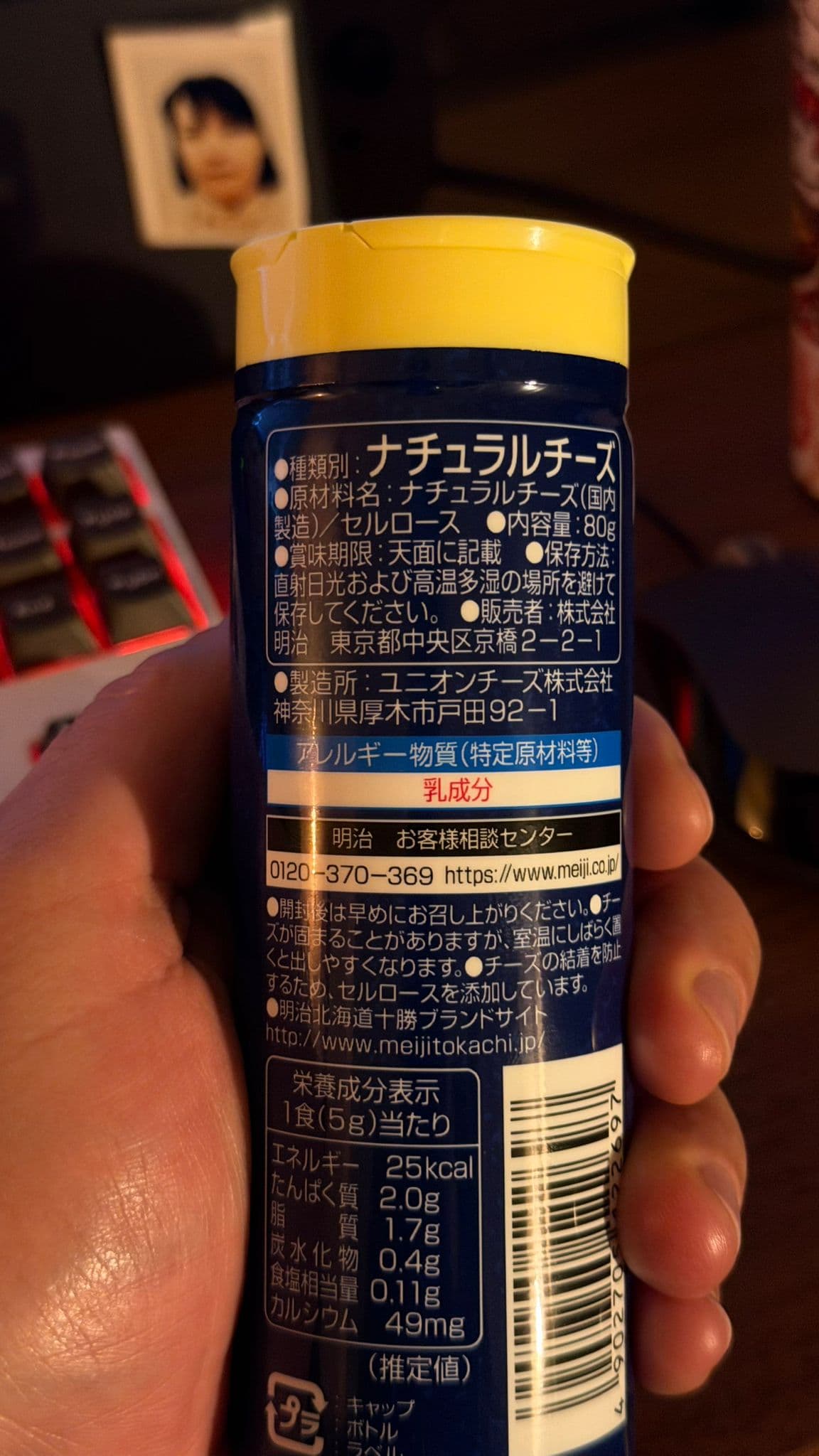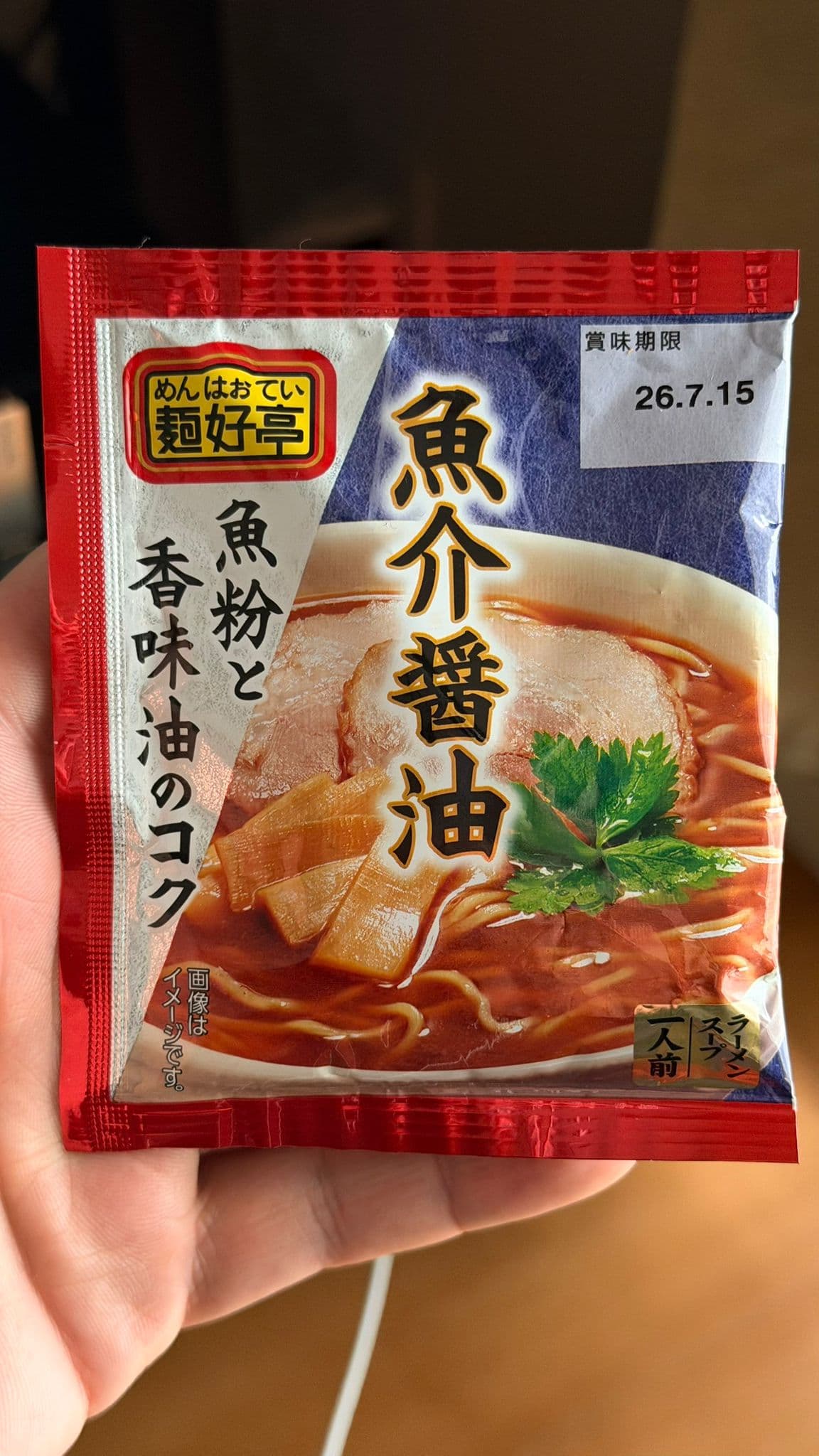
Under Japan's Food Labeling Standards (食品表示基準), a food label puts its required facts in one box of headings, such as 名称 (name), 原材料名 (ingredients), 内容量 (contents), the date, 保存方法 (storage) and the maker, with the nutrition table, 栄養成分表示, beside it (Consumer Affairs Agency, pamphlet for overseas visitors, August 2026). In 原材料名, ingredients come heaviest first, additives follow a slash (/) and allergens are named in brackets, after each ingredient or all together at the end as (一部に…を含む) (ichibu ni … o fukumu, "contains in part"). 賞味期限 (shōmi kigen) is a best-before date and 消費期限 (shōhi kigen) a use-by date, both written year, month, day: 26.3.10 is March 10, 2026.
The labels below were tested by Okaasan in November 2026, part of the 115 Japanese products in its label tests, and each line is copied from the photo. The rules are as of November 2026.
What is on a Japanese food label?
Packaged food sold in Japan carries a box of headings with its name, ingredients and additives, allergens, contents, date, storage method and the company responsible, plus a nutrition table, under article 3 of the Food Labeling Standards; the Consumer Affairs Agency's pamphlet for visitors shows the same box in English.
| Heading | Reading | Meaning | What to know |
|---|---|---|---|
| 名称 | meishō | Name | The kind of food, such as 調理麺 (prepared noodles) or 焼菓子 (baked confectionery); the brand name may be printed elsewhere |
| 原材料名 | genzairyōmei | Ingredients | Heaviest first; additives after a / or in their own row, 添加物 (tenkabutsu); allergens in brackets |
| 内容量 | naiyōryō | Contents | Weight, volume or count, such as 300g or 20枚 (20 pieces) |
| 賞味期限, 消費期限 | shōmi kigen, shōhi kigen | Best before, use by | Year, month, day; may be printed elsewhere if the box says where |
| 保存方法 | hozon hōhō | Storage | Such as 10℃以下 (10 °C or below) or 直射日光、高温多湿を避けて (away from sunlight, heat and humidity) |
| 製造者, 販売者, 輸入者 | seizōsha, hanbaisha, yunyūsha | Maker, seller, importer | The company responsible, with its address |
| 原産国名 | gensankoku-mei | Country of origin | On imported food |
| 栄養成分表示 | eiyō seibun hyōji | Nutrition facts | Usually outside the box |
The label is written in Japanese: article 8 of the standards requires 邦文 (hōbun, Japanese text), and the Consumer Affairs Agency says a foreign date such as 14.11.2025 doesn't count, so the importer must label the food in Japanese (CAA date labelling guideline, Q&A 期限(事)-19). A date powder from the United Arab Emirates, tested by Okaasan, carries a Japanese sticker with the whole box over its English pack, its importer named under 輸入者.
A real label, read line by line
One small label can hold the ingredients, the allergens, a factory warning, the date, storage, the maker and the nutrition table. Here is the whole label of a chilled fresh pasta, 生パスタ チーズボロネーゼ (nama pasuta chīzu boronēze, cheese bolognese), made by Yamawo (株式会社ヤマヲ), with its phone number and address left out:
名称 調理麺
原材料名 パスタ(国内製造)、ソース(ミートソース、トマト・ピューレーづけ、大豆たん白、玉ねぎ、その他)、チーズ、セミドライトマト、パセリ、黒こしょう/増粘剤(加工デンプン、アルギン酸エステル、キサンタン)、酒精、着色料(カラメル、クチナシ)、調味料(アミノ酸等)、pH調整剤、セルロース、乳化剤、グリシン、酢酸Na、酸味料、香料、酸化防止剤(亜硫酸塩)、(一部に小麦・卵・乳成分・牛肉・大豆・鶏肉・豚肉・ゼラチンを含む)
※当工場では、そば・卵を含む製品を製造しています
消費期限 別途商品名下部に記載 保存方法 10℃以下 製造者 株式会社ヤマヲ
生パスタ チーズボロネーゼ 消費期限 26.3.10 午前4時
レンジ加熱目安 1600w 1分 0秒 500w 3分 0秒
栄養成分表示 1包装当り(推定値) 熱量513kcal 蛋白質24.1g 脂質16.3g 炭水化物69.7g(糖質66.2g 食物繊維3.5g) 食塩相当量4.0g
| On the label | Reading | Meaning | What it tells you |
|---|---|---|---|
| 名称 調理麺 | meishō, chōrimen | Name: prepared noodles | The kind of food; the product name is printed under the box |
| パスタ(国内製造) | pasuta (kokunai seizō) | Pasta (made in Japan) | The heaviest ingredient, and where it was made, not where its wheat grew |
| ソース(ミートソース、…、その他) | sōsu (… sono ta) | Sauce (meat sauce, …, others) | A compound ingredient with its own list; その他 groups the smallest parts |
| / | Slash | The additives come after it, then the allergen bracket | |
| (一部に小麦・卵・乳成分・牛肉・大豆・鶏肉・豚肉・ゼラチンを含む) | ichibu ni … o fukumu | Contains in part: wheat, egg, milk, beef, soy, chicken, pork, gelatin | The allergen bracket; pork and gelatin are named nowhere else |
| ※当工場では、そば・卵を含む製品を製造しています | This factory makes products with buckwheat and egg | A factory warning: buckwheat is not an ingredient | |
| 消費期限 26.3.10 午前4時 | shōhi kigen, gozen yoji | Use by March 10, 2026, 4 a.m. | Printed under the product name, as the box says |
| 保存方法 10℃以下 | hozon hōhō | Store at 10 °C or below | Keep it chilled |
| レンジ加熱目安 | renji kanetsu meyasu | Microwave guide | 1 minute at 1,600 W, or 3 minutes at 500 W |
| 栄養成分表示 1包装当り(推定値) | ippōsō atari (suiteichi) | Nutrition per pack (estimated) | 513 kcal and 4.0 g of salt for the whole pack |

Not halal, vegan or vegetarian. 豚肉 (pork) and ゼラチン (gelatin) are named only in the closing bracket, and 酒精 (alcohol) is in the list. The pack holds 4.0 g of salt, 80% of a day's 5 g.
The label never says which meats are in ミートソース (meat sauce): only the bracket at the end names beef, chicken and pork. Okaasan's safety net reads that bracket and any allergen box as well as the ingredient list, so an allergen named only there still counts.
How do you read the ingredient list (原材料名)?
原材料名 lists ingredients from the heaviest to the lightest, and a compound ingredient made of several others is followed by its own list in brackets, also heaviest first, under article 3 of the Food Labeling Standards (Osaka Prefecture).
- その他 (sono ta, "others"). Inside a compound ingredient's brackets, the parts ranked third or lower that make up less than 5% of it can be grouped as その他, and a compound ingredient under 5% of the product can skip its list (same sources). An allergen inside その他 must still be named, in a bracket after the compound ingredient or in the closing bracket (CAA allergen Q&A, E-20).
- The slash. Additives come after the ingredients, separated by a slash (/), a line break or a row of their own headed 添加物, and are listed heaviest first among themselves; running them on without a break is not allowed (CAA Q&A on processed foods, 加工-248; Nagoya City).
- Origin. The heaviest ingredient shows where it comes from, on all processed food made in Japan since April 2022. For a raw ingredient that is the country or region, such as 国産 (kokusan, grown in Japan); for a processed one it is where it was made: 国内製造 (kokunai seizō) means made in Japan, not that its raw material is Japanese (standards, article 3; CAA Q&A on origin labelling, 原原-43; Osaka Prefecture).
- Additive names. Eight kinds of additive show their purpose with the substance, such as 着色料(カラメル、クチナシ) (colouring: caramel, gardenia); 14 groups may be written with a group name alone, such as 香料 (flavouring) or 乳化剤 (emulsifier) (tables 6 and 7 of the standards; Nagoya City).
The additives on the bolognese, after its slash:
| Japanese | Reading | Meaning |
|---|---|---|
| 増粘剤(加工デンプン、アルギン酸エステル、キサンタン) | zōnenzai | Thickener: modified starch, alginate ester, xanthan |
| 酒精 | shusei | Ethyl alcohol |
| 着色料(カラメル、クチナシ) | chakushokuryō | Colouring: caramel, gardenia |
| 調味料(アミノ酸等) | chōmiryō (aminosan tō) | Seasoning, mainly amino acids |
| pH調整剤 | pī-eichi chōseizai | pH adjuster, a group name |
| セルロース | serurōsu | Cellulose |
| 乳化剤 | nyūkazai | Emulsifier, a group name; 乳 here means emulsion, not milk |
| グリシン | gurishin | Glycine |
| 酢酸Na | sakusan natoriumu | Sodium acetate |
| 酸味料 | sanmiryō | Acidulant, a group name |
| 香料 | kōryō | Flavouring, a group name |
| 酸化防止剤(亜硫酸塩) | sanka bōshizai (aryūsan'en) | Antioxidant: sulfites |
More additive names, and why Japan doesn't use E-numbers: What Do Japanese Food Additive Codes Mean?
無添加 (mutenka, "no additives") on a pack means only that the additive it names was not added; under the Consumer Affairs Agency's 2022 guideline on no-additive claims, a bare 無添加 that doesn't say what wasn't added is one of 10 kinds of claims liable to mislead (CAA leaflet). The guide to 無添加 and same-factory labels reads real examples.
Where are allergens on a Japanese label?
Allergens are named in brackets inside 原材料名: after each ingredient, such as マヨネーズ(卵を含む) ("mayonnaise (contains egg)"), or all together at the end of the list as (一部に…を含む) (ichibu ni … o fukumu, "contains in part"), which then covers the additives too (a separate 添加物 row ends with a bracket of its own); a label can't mix the two ways (CAA allergen Q&A, E-6 to E-9; CAA allergen handbook, page 10).
Japan requires 9 allergens and recommends 20 more, as of November 2026 (CAA allergen Q&A, A-2; Sakai City):
| Japanese words on the label | |
|---|---|
| Required (9) | えび (shrimp), カシューナッツ (cashew), かに (crab), くるみ (walnut), 小麦 (wheat), そば (buckwheat), 卵 (egg), 乳 or 乳成分 (milk), 落花生 (peanut) |
| Recommended (20) | アーモンド (almond), あわび (abalone), いか (squid), いくら (salmon roe), オレンジ (orange), キウイフルーツ (kiwi), 牛肉 (beef), ごま (sesame), さけ (salmon), さば (mackerel), 大豆 (soy), 鶏肉 (chicken), バナナ (banana), ピスタチオ (pistachio), 豚肉 (pork), マカダミアナッツ (macadamia), もも (peach), やまいも (yam), りんご (apple), ゼラチン (gelatin) |
Cashew became required on April 1, 2026, with packs given until March 31, 2028 to change, and pistachio joined the recommended list the same day (CAA notice of April 1, 2026; Sakai City). A recommended item can be in a food without being named, and a food outside the 29, such as bonito or rice, may not be named as an allergen inside the label's box: the ingredient list shows it, and a maker may add a note of its own outside the box (CAA allergen Q&A, E-22; CAA allergen handbook, page 18). Alcoholic drinks don't have to carry allergen labelling (CAA allergen Q&A, C-9; CAA pamphlet for visitors).
Some packs also repeat the allergens in a box near the main label. Nanao Seika's 太鼓せんべい (taiko senbei, a peanut cookie), tested by Okaasan, closes its ingredient list with a bracket and prints this box beside it:
アレルギー物質(特定原材料等)
小麦・卵・落花生・大豆
The heading means "allergens (specified ingredients and others)". The Consumer Affairs Agency asks makers to say next to the label's box whether their allergen labelling covers only the 9 required items or all 29, with wording such as アレルゲン(29品目対象) ("allergens, 29 items covered"); a pack that says 28品目 follows the lists before April 1, 2026 (CAA allergen handbook, page 18; CAA allergen Q&A, E-23). The cookie's list starts with 小麦粉(国内製造) (wheat flour, made in Japan), 砂糖 (sugar), 落花生 (peanut), 鶏卵 (keiran, hen's egg) and マーガリン (margarine). 鶏卵 is egg, not chicken: chicken meat is 鶏肉 (keiniku).
Not vegan: 鶏卵 (hen's egg) is in the list. Vegetarian and halal are unclear, since マーガリン (margarine) doesn't say where its fat comes from.
Food sold without a pack, such as restaurant dishes, bakery bread or cakes from a display case, doesn't have to carry an allergen label: ask the staff (CAA pamphlet for visitors; CAA allergen Q&A, I-7). For a serious allergy, the maker or the staff have the last word. Words to say, emergency numbers and both lists in more detail are in the food allergy guide for Japan.
What does a "same factory" line mean?
A line such as 当工場では、そば・卵を含む製品を製造しています ("this factory makes products containing buckwheat and egg") warns that an allergen the food doesn't use is handled in the same factory or on the same line. The Consumer Affairs Agency recommends it when a trace can't be ruled out, doesn't require it, and bans vague wording such as 入っているかもしれません ("may be in it") (CAA allergen handbook, page 26; CAA allergen Q&A, H-1). On the bolognese, buckwheat is named only there; egg is in the bracket too, so it is an ingredient. A pack without such a line is no proof that its factory never handles the allergen.
How do you read the nutrition table (栄養成分表示)?
The nutrition table must give energy, protein, fat, carbohydrate and salt equivalent, in that order, for an amount stated in its heading: per 100 g, per 100 ml, per serving, per pack or per piece (standards, article 3; CAA nutrition labelling guideline, October 2026).
| Japanese | Reading | Meaning | Bolognese, per pack |
|---|---|---|---|
| 熱量 or エネルギー | netsuryō, enerugī | Energy, in kcal | 513 kcal |
| たんぱく質 (also 蛋白質, タンパク質) | tanpakushitsu | Protein | 24.1 g |
| 脂質 | shishitsu | Fat | 16.3 g |
| 炭水化物 | tansuikabutsu | Carbohydrate | 69.7 g (糖質 66.2 g, 食物繊維 3.5 g) |
| 食塩相当量 | shokuen sōtōryō | Salt equivalent | 4.0 g |
- Read the heading first. 1包装当り (ippōsō atari) means per pack, 100g当たり per 100 g, 1食当たり per serving. The bolognese's figures are for the whole pack.
- Salt is sodium times 2.54. 食塩相当量 is the sodium content converted to salt: grams of salt = milligrams of sodium × 2.54 ÷ 1,000 (same sources). The WHO advises adults to keep salt under 5 g a day (WHO); Japan's dietary reference intakes set a goal under 7.5 g for men and 6.5 g for women (Ministry of Agriculture, citing the 2025 intakes).
- 推定値 and 目安 mean estimated. 推定値 (suiteichi, estimate) or この表示値は、目安です ("these values are a guide") mark figures estimated, for example from food composition tables or from a sample, that may not match a lab test of the product itself (CAA nutrition labelling guideline, page 43; CAA Q&A on processed foods, 加工-109). The taiko senbei prints the second.
- 糖質 and 糖類 are optional lines under 炭水化物. What they mean, and what ゼロ, オフ and 無糖 allow: Carbs and Sugar on Japanese Labels.
What do 賞味期限 and 消費期限 mean?
消費期限 (shōhi kigen, use by) is the last day a food is safe to eat, printed on food that spoils fast such as bento, sandwiches, ready-made dishes, fresh sweets and fresh noodles; 賞味期限 (shōmi kigen, best before) is the last day it keeps its full quality, printed on snacks, instant noodles and canned food, and a food past it is not necessarily unfit to eat. Both dates hold only for an unopened pack kept as the label says (CAA date labelling guideline, Q&A 期限(消)-1 to -3 and -7; Sapporo City).
The taiko senbei says it on its own pack:
賞味期限は、外袋未開封で、表示した保存方法で品質が保たれる期限です。開封後はお早めにお召し上がりください。
"The best-before date is the date until which quality is kept with the outer bag unopened and stored as shown. Once opened, eat it soon."
How are dates written on Japanese labels?
Dates run year, month, day: 26.3.10, 2026.3.10, 26-3-10, 260310 and 令和8年3月10日 all mean March 10, 2026 (CAA date labelling guideline, Q&A 期限(事)-15; CAA pamphlet for visitors; Sapporo City).
- Two kinds of year. 26 is 2026. A year of one digit, or written 08, is the Japanese era: 令和 (Reiwa) 8 is 2026 and Reiwa 9 is 2027, so 8.3.10 is also March 10, 2026.
- Year and month only. A best-before date more than three months after the food was made may show only the year and month, and it then runs to the end of that month (guideline, 期限(事)-10).
- A time. A use-by date may add the hour, as the bolognese does: 26.3.10 午前4時 (gozen yoji, 4 a.m.). The agency calls this desirable for bento-type food, not required (guideline, 期限(事)-12).
- Printed elsewhere. The box may point to the date instead of holding it, but it must say where; a bare 枠外に記載 ("printed outside the box") or 別途記載 ("printed separately") is not allowed (guideline, 期限(事)-15; Sapporo City). The taiko senbei prints its best-before date, 27.01.28 (January 28, 2027), above its box.
| On the label | Reading | Meaning | Tested label |
|---|---|---|---|
| 枠外上部に記載 | wakugai jōbu ni kisai | Printed above the box | |
| 別途商品名下部に記載 | betto shōhinmei kabu ni kisai | Printed separately, under the product name | Bolognese: 26.3.10 午前4時 |
| 枠外下部に記載(E箇所) | wakugai kabu ni kisai (ī kasho) | Printed below the box, at the E | Date powder: E:25/12/2027, day/month/year, with a sticker 賞味期限2027年12月25日 |
| 午前, 午後 | gozen, gogo | a.m., p.m. | |
| 開封後はお早めにお召し上がりください | kaifūgo wa ohayame ni omeshiagari kudasai | Once opened, eat it soon |
Other words on Japanese food packs
Japanese food packs also print short words on storage, origin and organic farming, and a customer line for questions to the maker.
| Japanese | Reading | Meaning | What to know |
|---|---|---|---|
| 有機, オーガニック | yūki, ōganikku | Organic | Only food with the organic JAS mark (有機JASマーク) may say it (Ministry of Agriculture; CAA Q&A on processed foods, 加工-211) |
| 国産 | kokusan | Grown or raised in Japan | For a raw ingredient |
| 国内製造 | kokunai seizō | Made in Japan | For a processed ingredient; says nothing of where its raw material grew |
| 要冷蔵 | yōreizō | Keep refrigerated | |
| 要冷凍 | yōreitō | Keep frozen | |
| 開封後要冷蔵 | kaifūgo yōreizō | Refrigerate after opening | |
| お客様相談室 | okyakusama sōdanshitsu | Customer line | The number to ask the maker about ingredients or factory lines |
FAQ
Are Japanese food labels written in English?
No. Japan's Food Labeling Standards require the label in Japanese, so imported food carries a Japanese label added by its importer. English on a Japanese pack is optional.
How do you read a Japanese expiry date like 26.3.10?
Year, month, day: 26.3.10 is March 10, 2026. A one-digit year, as in 8.3.10, counts in the Reiwa era, and Reiwa 8 is 2026. A date with only a year and month, such as 2027.1, runs to the end of that month.
Can you eat food after its 賞味期限?
賞味期限 is a best-before date: Japan's Consumer Affairs Agency says a food past it is not necessarily unfit to eat, if the pack is unopened and was stored as shown. 消費期限 is a use-by date, the safety limit: food past it should not be eaten.
Where are allergens listed on a Japanese food label?
In brackets in the ingredient list (原材料名): after each ingredient, or together at the end as (一部に…を含む), "contains in part". Some packs repeat them in a box. Only 9 allergens are required and 20 recommended, as of November 2026.
What does the slash (/) in a Japanese ingredient list mean?
The additives come after the slash, listed by weight among themselves; when the allergens are listed together, their bracket comes last. Some labels use a line break or a separate 添加物 (additives) row instead.
Is 食塩相当量 salt or sodium?
Salt. 食塩相当量 (shokuen sōtōryō, "salt equivalent") is the sodium content multiplied by 2.54, so 1,000 mg of sodium shows as 2.54 g.
Scan the label
Scan the label with Okaasan: from one photo, it reads the ingredient list, the allergen bracket and box, the factory warning and the nutrition table, and checks them against the diets and allergies in your profile. From $9 a month, or $14 once for a 31-day Traveler Pass.