Ramen in Japan is not pork-free by default. Shio (塩, salt), shoyu (醤油, soy sauce) and miso (味噌) name how the soup is seasoned, not what the broth is made of (Japan National Tourism Organization), and the broth under any of them can be pork bone, chicken, seafood or a mix. Japan's food labeling rules don't apply to food served in a restaurant (食品表示基準, Article 1), so only the staff can say what is in the bowl: ask before you buy the ticket.
Are shio and shoyu ramen pork-free?
No, not by default: shio and shoyu say how the soup is seasoned, and the broth under that seasoning is often pork, chicken or both. A bowl of ramen is a broth (出汁, dashi), a seasoning poured into the bowl first (タレ, tare; the soy sauce one is also called カエシ, kaeshi) and an aromatic oil (香味油, kōmiyu), as ramen critic Hiroshi Osaki explains in All About and noodle maker Myojo describes.
- Shio, shoyu and miso are seasonings. Three of the four common ramen types are named after their seasoning; the fourth, tonkotsu, is named after its pork bone broth (JNTO, japan-guide.com). Tonkotsu itself is usually seasoned with a salt or soy sauce tare (Kikkoman), and Sapporo puts miso on a tonkotsu base (JNTO).
- A clear shio broth can be pork. In Hakodate, whose clear shio ramen is a regional style, well-known shops make the broth from pork bones (豚骨) and chicken (鶏ガラ) (るるぶ, 日本旅行 Tripa).
- Shoyu is often pork or chicken underneath. Tokyo's classic style is "a dark, pork bone or chicken-based shoyu" (JNTO), and a shoyu broth "may contain pork, beef or fish depending on the region" (japan-guide.com).
Okaasan's label tests include a 51 g ramen soup packet (ラーメンスープ, sold by Foodlier) whose first ingredient is soy sauce. Its ingredient list, as printed:
醤油(国内製造)、食塩、動物油脂、たん白加水分解物、香味油、いわし煮干粉末、さば節粉末、かつお節エキス、ポークエキス、砂糖、魚醤、酵母エキスパウダー、香辛料、ガーリックエキス/増粘剤(加工でん粉、キサンタン)、調味料(アミノ酸等)、カラメル色素、酸味料、酸化防止剤(ビタミンE、ローズマリー抽出物)、香辛料抽出物、(一部に小麦・さば・大豆・豚肉を含む)
Soy sauce first, then sardine, mackerel and bonito, and in the middle ポークエキス (pōku ekisu, pork extract) and 動物油脂 (dōbutsu yushi, animal fat). Tested by Okaasan in November 2026, it came out with pork and not halal 3 times in 3.

Not pork-free. ポークエキス (pōku ekisu) is pork extract, in a soup that starts with soy sauce and fish.
Which words mean pork on a ramen menu?
On a ramen menu or a ticket machine, 豚 (buta), 豚骨, チャーシュー, 背脂 and ラード mean pork. These are the words to look for:
| Japanese | Reading | Meaning | What it changes |
|---|---|---|---|
| 豚骨, とんこつ | tonkotsu | Pork bone broth | The broth itself is pork (JNTO, japan-guide.com) |
| 豚, 豚肉, ポーク | buta, butaniku, pōku | Pork | Pork |
| チャーシュー, 叉焼, 焼豚 | chāshū, yakibuta | Roast or braised pork (デジタル大辞泉, Kikkoman) | Pork, on top of any broth |
| チャーシューめん | chāshū-men | Ramen with extra chashu | Pork |
| 背脂 | seabura | Pork back fat, shaken over the bowl through a sieve (Time Out Tokyo, マイナビニュース) | Pork, even in a shio or shoyu bowl |
| ラード | rādo | Lard | Pork |
| 角煮 | kakuni | Braised cubes; on a ramen, pork belly (japan-guide.com) | Pork in ramen; the word alone also covers fish (デジタル大辞泉) |
The broth and seasoning words say less than they seem to:
| Japanese | Reading | Meaning | What it changes |
|---|---|---|---|
| 鶏ガラ | torigara | Chicken carcass broth | Chicken, often simmered with pork bones (Hakodate, above) |
| 鶏白湯 | tori paitan | Creamy chicken broth (Kikkoman, Myojo) | Chicken |
| 魚介 | gyokai | Fish and seafood broth | No pork in itself, but "sometimes combined with meat-based stocks" (Kikkoman) |
| 煮干し | niboshi | Dried sardines | Fish |
| 牛骨 | gyūkotsu | Beef bone broth, a Tottori style (鳥取県, JNTO) | Beef |
| 塩 | shio | Salt seasoning | Nothing about the broth |
| 醤油 | shōyu | Soy sauce seasoning | Nothing about the broth; soy sauce holds some alcohol |
| 味噌 | miso | Fermented soybean paste | Nothing about the broth |
The sign ノンポーク (non pōku, no pork) on a menu means the shop left pork out. It is not a halal certification (next section).
Is chicken or seafood ramen halal?
Not by default: chicken and beef are halal only when slaughtered by Islamic rules, and some Muslims also avoid the alcohol in soy sauce. Japan's tourism agency writes both in its guide for restaurants, and names shoyu ramen as a dish to be careful with (観光庁, April 2024, page 25); Fukuoka Prefecture's guide says the same about chicken and beef (福岡県). How strictly each person avoids these varies, and the tourism agency's guide advises leaving that choice to them (観光庁, page 29).
- Chicken broth. 鶏ガラ and 鶏白湯 are chicken. Halal-certified chicken and beef exist in Japan, often imported from Brazil or Australia (観光庁), but a menu that doesn't say so gives no way to tell.
- Seafood broth. In its miso udon example for Muslim guests, the tourism agency keeps the fish dashi and changes the chicken to halal-certified chicken, the miso and soy sauce to alcohol-free ones and the mirin to sugar (観光庁, page 11). A ramen's seafood broth, though, is often one half of a mix: the soup packet above has bonito, sardine and pork extract in one list.
- Alcohol. Mirin and cooking sake (料理酒, ryōrishu) are alcohol (福岡県). Brewed soy sauce holds some alcohol from fermentation: over 2% by volume in Kikkoman's traditional soy sauces (Kikkoman USA), and the Wadakan koikuchi soy sauce tested by Okaasan in November 2026 also lists アルコール (alcohol) among its additives. Opinions differ on whether such small amounts count (観光庁), so on a label, Okaasan shows halal as "unclear" when soy sauce, miso or a fermented seasoning is the only doubt.
- The kitchen. A bowl without pork from a tonkotsu shop is cooked in the same kitchen as the pork bowls. Halal certification covers the kitchen, the utensils and the dishes; a "Muslim-friendly" shop keeps utensils and dishes apart but shares the kitchen; a "no pork" sign covers the ingredients only (観光庁, page 30).
More on halal ingredients in Japanese food: Is food in Japan halal?
What do instant ramen labels show?
On packaged ramen, pork shows up in the ingredient list (原材料名, genzairyōmei), often inside the brackets of the soup. Read the list itself: pork is one of Japan's 20 recommended allergens, not one of the 9 mandatory ones, as of November 2026 (消費者庁, 京都府).
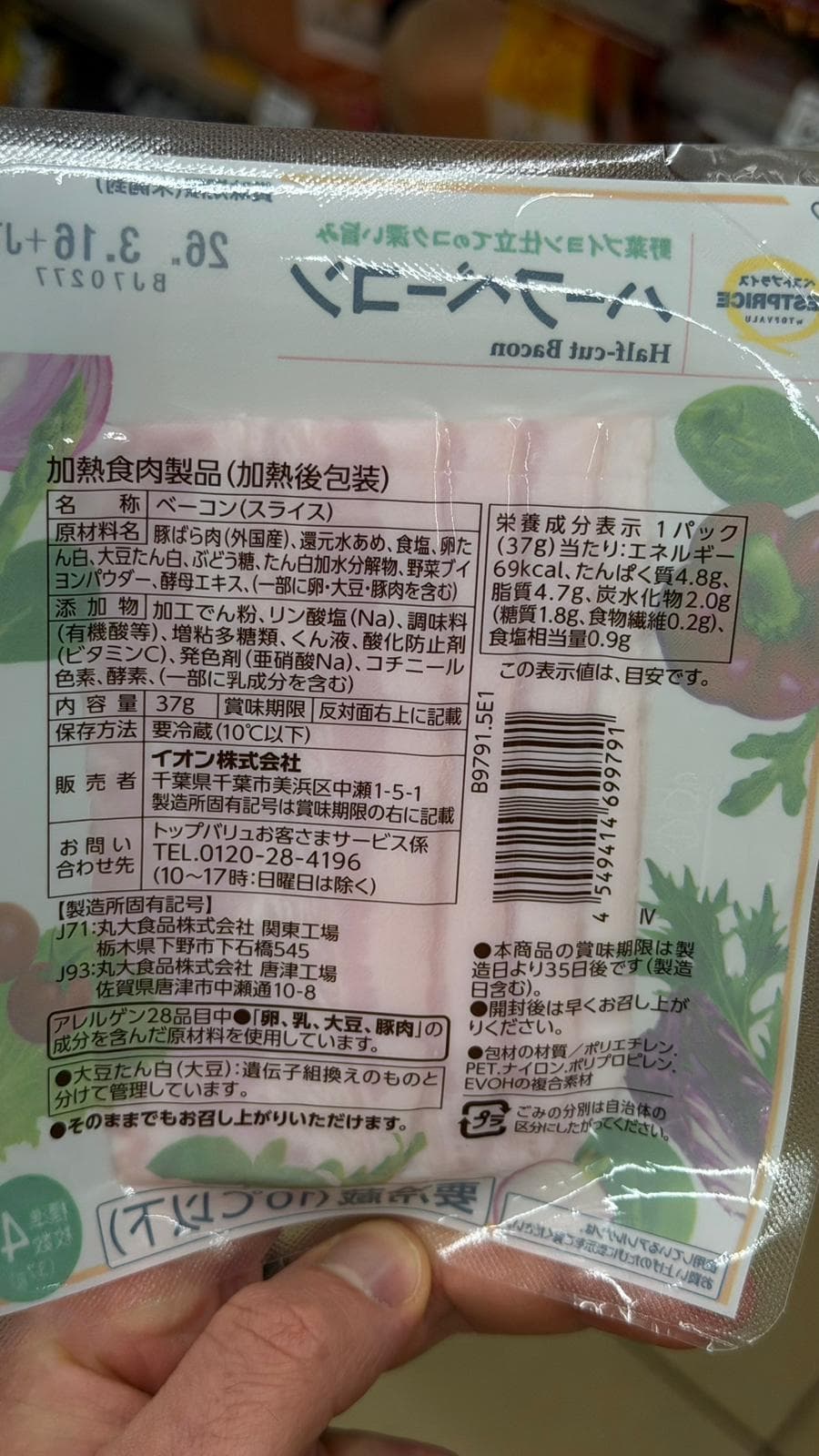
AEON instant ramen, blue pack. The soup's bone stock base, がらスープの素 (gara sūpu no moto), doesn't name its animal. Its bracket does:
スープ[食塩、がらスープの素(乳成分・小麦・牛肉・ごま・大豆・鶏肉・豚肉・ゼラチンを含む)、砂糖、香辛料(オニオン(大豆を含む)、セロリ、黒こしょう、ナツメグ、ターメリック)、チキンエキスパウダー、かつお節エキスパウダー]
Beef, chicken, pork and gelatin, all inside one ingredient. Okaasan showed it with pork and not halal 3 times in 3. In Okaasan's comparison of general AI apps on the same 115 labels (2026-11-12), Gemini (Auto) answered that this pack has no pork; ChatGPT (GPT-6.1) and Claude (Opus 5.5) found the pork (how Okaasan tests).
AEON instant miso ramen, orange pack. The soup is seasoned with powdered miso, and pork comes next:
スープ[粉末みそ(大豆を含む)、食塩、砂糖、ポークエキス調味料(小麦・大豆を含む)、ガーリックパウダー、オニオンパウダー、ジンジャーパウダー、唐辛子]
Its allergen box names 豚肉 (pork), and adds that the same production line handles milk, squid, beef, sesame, chicken and gelatin.
Not pork-free. ポークエキス調味料 (pōku ekisu chōmiryō) is pork extract seasoning, in the miso soup packet.
Does a ramen shop have to tell you if there is pork?
No. Japan's Food Labeling Standards don't apply when food is served to eat on the premises (食品表示基準, Article 1), so a ramen shop has no legal duty to list pork, allergens or anything else (三重県).
Some shops say it anyway. Japan's tourism agency describes four levels a restaurant can offer Muslim guests (観光庁, page 30):
| Sign | What the shop does |
|---|---|
| ハラール認証 (halal certified) | Certified by a halal body: halal ingredients only, its own kitchen, utensils and dishes |
| ムスリムフレンドリー (Muslim-friendly) | Ingredients suited to Muslims and utensils kept apart; the kitchen is shared and alcohol may be sold |
| ノーポーク・ノーアルコール (no pork, no alcohol) | Pork and alcohol left out of the dish, nothing more |
| 情報開示 (information) | Pictograms or a written policy, so guests can decide |
Shops in Fukuoka, for example, put ノンポーク and ノンアルコール stickers on their menus (福岡県). Halal and Muslim-friendly ramen shops exist, in Tokyo for example (JNTO, nippon.com); shops open and close, so check the certificate on the day.
How do you read a ramen ticket machine?
Many ramen shops take orders through a ticket machine (券売機, kenbaiki, also 食券機, shokkenki): you pay first, press the buttons for your bowl, toppings, sides and drinks, and hand the tickets to the staff (JNTO, japan-guide.com).
- Read the whole machine before you put money in. Bowls come first, then toppings, sides and drinks.
- Look for the pork words of the table above on each button, and for 鶏 (chicken), 魚介 (seafood) or 野菜 (vegetables) in a bowl's name.
- If a button names only 塩, 醤油 or 味噌, the machine doesn't tell you the broth. Ask before you pay.
- Hand over the ticket and say what you asked for, such as chāshū nuki de (チャーシュー抜きで, without chashu).
Okaasan's ticket machine test comes from a soba and udon shop, not a ramen shop. It shows how Okaasan reads a machine button by button. The machine has 54 named buttons: hot dishes, sets (定食, teishoku), cold dishes (冷し, hiyashi), and toppings to add (追加, tsuika) that repeat the dishes' names at a lower price, such as かき揚げ at 530 yen and かき揚げ 追加 at 130 yen. There is also 冷し変更 (make it cold, 60 yen) and 大盛追加 (large portion, 170 yen). Tested by Okaasan in November 2026, 3 analyses: all 54 buttons read each time, 90 of 90 prices right, dishes and toppings never mixed up. Okaasan's AI alone called 合鴨山菜 (aigamo sansai, duck with mountain vegetables, 660 yen) vegetarian 3 times in 3; Okaasan's safety net corrected it every time.
The curry buttons led to a new rule in Okaasan's safety net. カレーライス (curry rice, 680 yen) came out pork-free 2 times in 3 even after the check, because nothing in the name says meat. A Japanese curry roux can hold lard, beef fat or meat extract (観光庁, page 8): the retort chicken curry Hachi 赤からカレー, tested by Okaasan in November 2026, lists 食用油脂(牛脂、豚脂), beef and pork fat, while its allergen bracket names no pork; Okaasan read the 豚脂 and showed pork 3 times in 3. Since 2026-11-13, a curry on a menu is never shown pork-free, halal or vegetarian for sure, unless the menu calls it vegan or halal; run again 3 times, 0 shown fine against the menu.
Pork: unclear. カレー (karē) on a button names no meat, and a curry roux can hold lard or beef fat.
What can a ramen menu tell, and what can't it?
A ramen menu names the bowl and its seasoning, rarely the broth, so any diet answer for a plain shio or shoyu bowl is a deduction, not a fact. Only the staff know the recipe.
One of the menus in Okaasan's tests is a ramen shop's price card. It lists 味噌らーめん, 醤油らーめん and 塩らーめん at 850 yen each, チャーシューめん at 1,150 yen in any of the three (味噌、醤油、塩), toppings such as チャーシュー (300 yen), 煮玉子 (nitamago, seasoned egg, 150 yen) and かまぼこ (kamaboko, fish cake, 200 yen), and drinks from ラムネ (ramune, a soda) to ビール (beer). The card never names a broth: no 豚骨, no 鶏.
Tested by Okaasan in November 2026, 2 analyses: all 19 lines read both times, チャーシューめん read at 1,150 yen and shown with pork and not halal both times, beer shown with alcohol and not halal both times. For the three bowls named only by their seasoning, Okaasan showed vegetarian and vegan as not suitable both times. Whether their broth is pork, the card doesn't say, so ask.
The same reading applies to izakaya menus, where dashi and pork hide in dish names: How to read an izakaya menu.
What should you ask before buying the ticket?
Ask about the broth, the fat and the toppings, in that order: leaving out the chashu leaves the broth and the fat as they are. Show the Japanese to the staff, or say it:
| Japanese | Say it | Meaning |
|---|---|---|
| 豚肉が食べられません。 | Butaniku ga taberaremasen. | Can't eat pork. |
| スープに豚は入っていますか。 | Sūpu ni buta wa haitte imasu ka? | Is there pork in the soup? |
| ラードや背脂は使っていますか。 | Rādo ya seabura wa tsukatte imasu ka? | Do you use lard or pork back fat? |
| チャーシュー抜きにできますか。 | Chāshū nuki ni dekimasu ka? | Can you leave out the chashu? |
| お酒やみりんは入っていますか。 | Osake ya mirin wa haitte imasu ka? | Is there sake or mirin in it? |
| ハラールのメニューはありますか。 | Harāru no menyū wa arimasu ka? | Do you have a halal menu? |
A staff member's answer is the best information a restaurant can give, and it can still miss a seasoning or a shared pot. For a strict halal diet, a certified shop is the only settled answer. For a vegan bowl, see Vegan and vegetarian food in Japan.
FAQ
Is tonkotsu ramen always pork?
Yes. 豚骨 (tonkotsu) means pork bone, and the name describes the broth itself. Some shops mix it with chicken or seafood broth, but the pork stays.
Is shio ramen halal?
Not by default. Shio means the soup is seasoned with salt. The broth can be pork bone, chicken or both, and chicken is halal only when slaughtered by Islamic rules. Ask the staff, or choose a halal-certified shop.
Is chicken ramen pork-free?
Sometimes, so ask. 鶏ガラ (torigara) and 鶏白湯 (tori paitan) are chicken broths, but shops often simmer chicken with pork bones, top the bowl with pork chashu or add pork back fat (背脂).
Can you order ramen without chashu?
Often, by asking for chāshū nuki (チャーシュー抜き, without chashu). It takes the pork slices off the bowl, not the pork in the broth, the fat or the seasoning.
Is instant ramen in Japan halal?
Not by default. Read 原材料名 for ポークエキス, 豚脂, ラード or 豚肉, and for chicken or beef extract, halal only from halal slaughter. Two AEON packs tested by Okaasan, a plain one and a miso one, both had pork in the soup. A halal certification mark on the pack is the sure sign.
Is there halal ramen in Japan?
Yes. Halal-certified and Muslim-friendly ramen shops exist, in Tokyo for example. "Muslim-friendly" and "no pork" are lower levels than certification, and shops change, so check the certificate when you go.
Scan the menu or the ticket machine
Okaasan reads a ramen menu, a ticket machine or an instant ramen label from one photo, and shows for each dish or product whether it holds pork or alcohol and whether it fits halal, with the Japanese word that decides it. Scan the menu with Okaasan: from $9 a month, or $14 once for a 31-day Traveler Pass.